Thursday, October 30, 2014

Secretly praying while falling asleep

Chapter 2 The Secret Life of Paintings R. Foster & P. Tudor-Craig

Where are they?

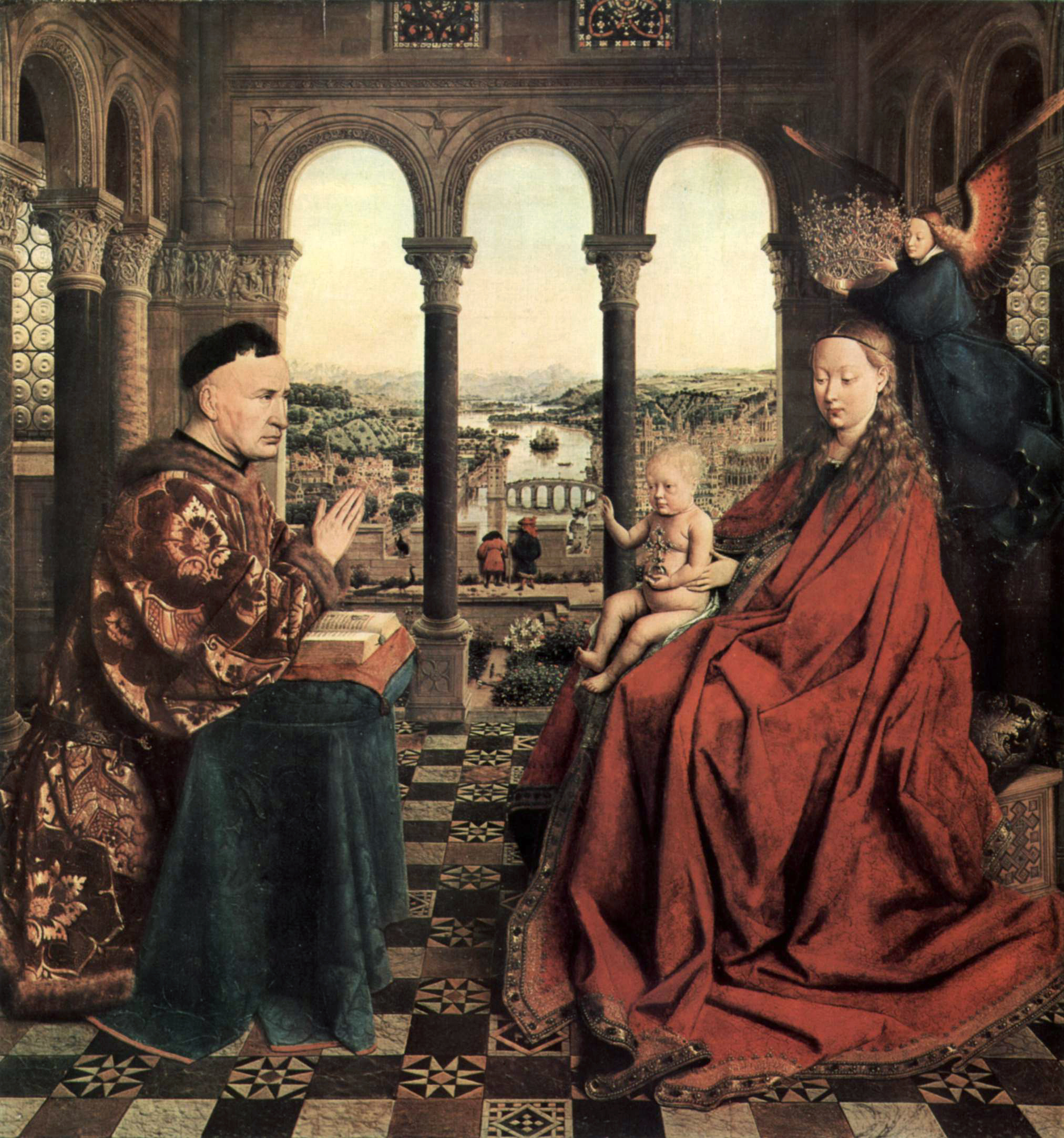
The next aspect the book focuses is where the two characters are located. It spends most of the time circling around the room in an abstract matter rather than a strict geographical point.

We first are introduced to Chancelor Rolin's style of conducting business--which is a very private matter without an intermediary. The book declares that the choice to portray Rolin privately without a saint present is at the very least piquant. But that aside we can infer just like his business practices, this meeting is conducted in private.


Some side information is included about how prayer practices at the time could be considered by two different modes. Those are in private and in public. Even public spaces such as cathedrals were at times curtained off into identical private spaces for personal prayer. But this location we consider in the painting isn't so humble as a curtained square.


There is another comparison between cathedrals and castles, but in a hierarchical way in which the cathedral borrows the language of fortification that was needed in a very real way to protect nobility to say something different about the need to protect the soul.

The room we are in is in the same way like the Madona portrayed. Particularly the arches are done in a style different from what was contemporary at the time. And the book describes the room as atop the tallest spire and conjured by the painter rather than based on an actual room. The spire is also described as the safest place in a fortification provided the ground it stands on is stable. It is also the space that allows for decorations that involve windows and open spaces as it isn't concerned with flinging arrows and people knocking.


Amphiaraus Imagines Philostratus

Amphiaraus is doing something curious and to me it's hard to comprehend or explain. It seems like he's riding a chariot into ground and maybe the ground begins to have the qualities of water. Yet this character is definitely a heroic person and this task is by no means ordinary. We are told there were other heros who were claimed by the earth and never came back.


Amphiaraus seems to have prepared himself for something grand being in full armor except leaving his head exposed. He is not gently going to sleep and his chariot horses are exerting themselves to the point where they are not depicted as ideally beautiful. But the god of dreams himself is cool and collected wearing a black garment covering a white one.

All this activity and the combination of the collected dream god demonstrates how one acquires wisdom which is heroic and buried.

Tuesday, October 28, 2014

Modona and child theif

Chapter 2 The Secret Life of Paintings R. Foster & P. Tudor-Craig


Who are the people? 

This chapter sets about discovering Van Eyck's painting 'The Madonna and the Chancellor Rolin.' The method is intended to be orderly and is predicated by a list of sequential letters. As the focus seems to be on bringing unrealized facts to consciousness there are also latent psychological themes that are present. These psychological themes seem more important but the discussion heavily dotes on matter-of-facts.

The first section begins a scrutiny of the two figures that are directly in front of us. The first figure that is mentioned is a woman and a child. The woman was painted from life but her personal life is not expressed in the portrait but used for her appearance of beauty, youth, and used to idealize motherhood. As the book scans her for odd peculiarities it finds she is a similar model used by the painter for other paintings where she takes on similar roles. The baby also seems to reoccur and it's deduced that Van Eyck used studies from a particular sitting for work that spanned decades. Her presence is similar and the paintings seem to variate slightly.


The Madonna figure is painted in a way suggesting the figure is coming into being. The book suggests this because of her posture and relating it to similar practices that are tied to sculptural depictions of the same figure. Also keeping in mind this character is not depicting someone who the painter has met and there is an element of fancy and definitely one of transforming an ordinary woman into the emblem of religious motherhood.

The man depicted is treated with much more scrutiny but also treated as real. The book almost desecrates him and being real he seems much more dubious than the woman who has been transformed. "More striking than handsome," as the book describes him. The man is the one Nicholas Rolin--a ambitious sort who commissioned the painting. The painting's intention is described as a person piece for him to contemplate and hopefully contrive miracles through observation of the divine symbols in it.


While it may speak to opulence and narcissism of the character, it also focuses on a need for piety. The subject is a man who is mired in the strings of finance but displays a want for divine. The woman is a Jungian archetype who's function is to make present the intentions of what the mind has ordered that is unknown and her guise is one of holiness rather than a earthly or sexual apparition.

Birth of Hermes Imagines Philostratus

Hermes is born in a place so foreign from where humans live that he must be divine. On top of the mountain of Olympus there is little to nurture human life or to daunt them for that matter. Hermes takes the place for many things but here he is a thief--and still a child. His antics are not caused by greed and oddly epicurean.


Cows so purely white they correspond to Apollo are sneakily cowherded into the earth in some unexplainable way. When Apollo tries to get his cows back he sounds like a fool and becomes angry. Instead of reconciling with Apollo, Hermes has another target. He gets caught stealing Apollo’s arrows. The baby that was showered with nice flowers and dressed in fine clothing then turns fury into pleasure.

Saturday, October 25, 2014

Mything the point but there's plenty of wine

Franz Kafka 'Sancho Panza' Illuminations Walter Benjamin


In the final passage of the essay we get a tug of war between myth and I guess what happens when one turns away from myth. Much of this part was unclear to me but it seems to set up this turning point in history where myth was once common place but now it's tending towards this modern phase where myth is suppressed. Perhaps Kafka's story live in this world where these myths are displayed almost as if they are but are impotent without any foundation. However, I cannot be sure this is what is being expressed--it's just the only thing I can think after reading it.

Andrians Imagines Philostratus


This little bit talks about the Andrian people and the rive of wine that runs through Andros. it seems to have unnatural origin but springs from the very nature that wouldn't produce it normally. It also seems to be of use only for humans but it makes the people happy as Philostatus says 'on either side of the bank.' The scene described here is more harmonious than ones about Dionysus in the past where women tear apart relatives. Although I'm strangely sceptical about the sereness of this landscape or that it is actually a natural setting that can nurture people's bodies. It supposes culture can be generated by nature itself.

Thursday, October 23, 2014

No future for hyacinths

Franz Kafka "The Little Hunchback" Illuminations Walter Benjamin

Knut Hamsun starts us off in this segment of the essay. Wikipedia says he was an influential writer for Kafka, Benjamin does not relate this. What Benjamin does let us know is he would write editorials for news papers from time to time. The one in particularly noted is where Hamsun decides to cut his ties from the town he lives in over a trial of a mother who murdered her child but wasn't punished harshly.

After this Benjamin hurries to announce that Kafka cannot be interpreted naturally, supernaturally, psychoanalyticly, or theologically. I'm not sure what could be left but an emphasis of loss of essence and embodiments of repression.
In the stories which Kafka left us, narrative art regains the significance it had in the mouth of Scheherazade: to postpone the future. 
We have again the theme of judgement but now we pin it more directly to Kafka outside side of his stories to reveal how his stories reflect him as a person. 
His testament orders their destruction. This document, which no one interested in Kafka can disregard, says that the writings did not satisfy their author, that he regarded his efforts as failures, that he counted himself among those who were bound to fail.  
The intense anxiety that seeps through also seems to embody in Benjamin's criticism. Particularly how he does away with essential qualities of what he speaks of and we observe only the remnants of what is left after he annihilates them. This particularly happens in previous essays about what stories are. At first he says they come about by labor and then he says they phantoms using death as their muse and their meanings are obscure as a requisite.

Hyacinthus Imagines Philostratus

Here we read about the dubious throw of a discus by Apollo. I believe that he is also a god that shares likeness to the sun so maybe his discus throw is related to the sun rising and setting.

But the throw is described as a technical matter. To throw it means the body is shaped in a certain way that one has to look not where it is going to be thrown but at the grown. Which is also tied to Hyacinthus who is killed by the errant discus but is transformed into a flower that bares his name. The bloom of flowers resembles his curly hair.

Apollo did not mistake anything in his throw but the path of the discus was altered by god that oversees the wind. Curiously he was being mischievous but there seems to be a bit of eros in it being that this god has a crown of flowers.


Tuesday, October 21, 2014

Boy wonderfully depressed and reflecting himself

Franz kafka 'A Childhood photograph' Illuminations Walter benjamin

This passage seemed hard to comprehend but I'll try. It first starts out with the muse of Kafka's photograph of him as a young boy. In the strangeness that benjamin is cultivating we consider him as a sad boy in an essay memorialising his death.


I'm not sure how it segways into the rest of the essay but he begins to talk how Kafka was the writer of non-religious parables. Kind of furthering Benjamin's inference about stories he's mentioned in past essays. Setting them up to be something with essence and then truncating them in way that they still exist but altered in a way that one has to contemplate their actual motive for being read.

Kafkas stories are imbued with a strange ethereal quality. Benjamin has declared them non-religious parables but hasn't put to mind what purpose a non-religious parable is for other than to marvel at its otherness.

Narcissus Imagines Philostratus

Narcissus is the boy who falls in love with his own reflection. Curiously he seems to be similar to olympus in his lack of awareness of what's around him. Unlike olympus he is not communing with nature but rather being deceived by it--maybe willing.


His love for himself is also put in simile with the hunt he just finished. The author says he can not tell if his exhausted expression is from the hunt or his desire for his image.


Another curious thing is how the painting itself is described as being true to life. It's almost as if it was reflected and there's a mention of a bee being painted so realistically that it could be considered real. This might be alluding to an old art history story where two painters contest each other's ability. One fools a bee to think his flowers are real while the second painter fools the first into think his painting is behind a curtain when it is actually a painting of a curtain.

Saturday, October 18, 2014

Jokers talking about horses

The storyteller Illuminations Walter benjamin [XV-XIX]

The essay stumbles to an end. Each new section marked by a progressing number seems to be eyeing what follows it in alienation. The tides are also turn somewhat in that Benjamin first distanced himself from the novel but now seems to hold myth in suspicion, too.
It is evident that this story reflects the traditional sympathy which storytellers have for rascals and crooks. All the literature of farce bears witness to it. 
 
The essay does mirror the methods of farce with it's twists and turns--marching numerical headers with tracts about uniting the soul and the hand. Not only does he ruminate on this, but also announces that it no longer exists.
With these words, soul, eye, and hand are brought into connection. Interacting with one another, they determine a practice. We are no longer familiar with this practice. The role of the hand in production has become modest, and the place it filled in storytelling lies waste.
Further we hear the story teller is this shadowy noble-asshole. Unrestrained from morality but his stories are an honest mash of personal and heard stories that have no boundary between the two. To descend into the unconscious room of myth one must take away rational boundaries to avoid being a teller of mere facts.  
The old co-ordination of the soul, the eye, and the hand which emerges in Valery's words is that of the artisan which we encounter wherever the art of storytelling is at home.

Midas Imagines Philostratus

Midas has for some reason captured a satyr. In the past few passages we've seen a few cameos from this creature. At first satyrs were admiring beauty of nature and nature personified. What the king would do with such a drunken beast is not explained but Midas does relate to the creature in that he has some animal features.

Since they relate they might two versions of the same mind. One is asleep and the other in a drunken stupor. One wears cultivated clothes while the other was just snatched from the forest. And the story of Midas has nature to blame for spreading the rumor of his animal ears which come to think of it is interesting being listening the organ which was altered.

Remembering the end

The story teller Illuminations Walter benjamin [XII-XIV]

The essay begins a to knead into myth and contrast between the epic poem and the modern novel. Both seem to involve memory but have different natures between them. They seem to match to Jung's description of the mind regarding the unconscious and the conscious. The epic is the unconscious while the novel is consciousness.
This is epic remembrance and the Muse-inspired element of the narrative. But this should be set against another principle, also a muse-derived element in a narrower sense, which as an element of the novel in its earliest form--that is, in the epic--lies concealed, still undifferentiated from the similarly derived element of the story. 
The need for the epic is the generative element in the novel but the novel treats this memory in such a way that transforms the story and alters it. The novel brings a theme from the first essay about collecting. The altered memory does not strive for unity of one story but takes on a collecting character involving multiple tales.

The novel is also given characteristics of time and ownership. Unlike myth, which is woven, the novel involves memories that lead to an end. The termination is final and does lead to be rewoven in a way an epic myth does.
The novelist on the other hand, cannot hope to take the smallest step beyond that limit at which he invites the reader to a divinatory realization of the meaning of life by writing "Finis."